Weekly Blog
Here our minister shares a weekly reflection:
Sunday, 23 August 2026 — Peter and the body of Christ
This Sunday Peter finds himself at the heart of the gospel story once more. Two weeks ago, he stepped out onto the water to walk towards and promptly sunk when the waves and wind became overbearing. A low point and reality check for him, the one with little faith. Yet, this week, when asked who he thinks Jesus is, he answers swiftly, confidently, and most importantly, correctly! “You are the Messiah, the son of the living God”.
We swing from embarrassing failure to glorious success, and now Peter is praised, as Jesus points to the gift from God that he has been given that has meant Jesus’ identity has been fully revealed to him. He is able to recognise Jesus as the Son of God, and as a result, we hear that he will become the rock of the church. This very human person, prone to blunders and mistakes, who will later deny Jesus when he is arrested, will become the foundational in the building up of God’s people.
This is good news, not just for Peter, but for all of us. For Peter in the gospel story is much more than a historical figure that a select few will follow in the footsteps of (such as the line of Popes). He represents all people who encounter the gospel and seek to follow Christ. At some point the question is asked of us, ‘who do you say I am’, and following on from the ups and downs of life, in light of our experiences of the living God, may we too be able to respond, recognising Jesus as the Messiah. The church is built upon the rock of the many different people who respond faithfully to this call.
This is why it is important that the lectionary places the commissioning of Peter alongside verses from Romans 12 that highlight the different gifts given to all of the members of the body of Christ. The gift of leadership is not claimed by Peter, but given to him, and despite his imperfections he lives it out in the community of believers. This group of Jesus followers is not only on that he is to lead, but one that will also hold him, and all other leaders in the church to account.
All of Jesus’ followers have different gifts that will become the foundation stones for healthy, life-giving community. Together, as they share their gifting and different experiences, they will bring freedom from the things of this world that bind us and prevent us from living in right relationship with God and with each other. Together, they will reveal to others the good news that Jesus is the Messiah, the son of the living God.
Sunday, 16 August 2026 — Nevertheless, she persisted
This week, in our reading from the Gospel of Matthew, Jesus and his disciples encounter a Canaanite woman who pleads for her daughter to be healed. She cries out seeking mercy.
In a discomforting few verses, we hear the disciples seek to have her sent away, as they are annoyed by her shouting and then, Jesus speaks with her, likening her to a dog as she is a Canaanite. Up until this moment, Jesus is sure that he was sent only for the ‘lost sheep of Israel’.
As the woman calls him Lord and persists in requesting even the crumbs that fall from the table, we see that in this moment, Jesus learns something of the nature of his mission. This woman’s daughter is not to be denied the mercy of Jesus’ power to cast out demons on account of her ethnicity.
In contrast to the ‘little faith’ that Peter displayed last week as he tried to walk on water, this Canaanite woman shows ‘great faith’. As she does so, she prevails over the stereotypes attached to her ethnicity and gender, and we see, alongside the gospel writer and Matthew’s early church community, how the good news and ability to become ‘children of God’ is expanded beyond the house of Israel as it once was.
This week, you might want to stop and give thanks for those who persist in seeking after grace and mercy in the face of the injustice of racism and other forms of discrimination. We see people persisting in the pursuit of justice week by week in the news, in places such as Gaza and the West Bank, in campaigns for access to medical care and safe water, following different mistakes that have occurred in places such as hospitals, or in seeking after reparations for injustices such as the slave trade.
Those who persist in such ways, seeking justice for others, open our eyes to the vast horizon of God’s kingdom and help us to overcome the different prejudices that have been handed down to us over the generations. Just as Jesus learns something new regarding the grace he offers, I hope we too will do so as we encounter those in need whom we might otherwise overlook.
Sunday, 09 August 2026 — Focusing on What's Important
Many thanks for the messages, cards, and the present I received from the church to mark my 40th birthday. After visiting my family on the Isle of Arran, Helen and I spent a couple of days on Islay, where we visited a couple of distilleries, enjoyed some good food, and I ran a half marathon.
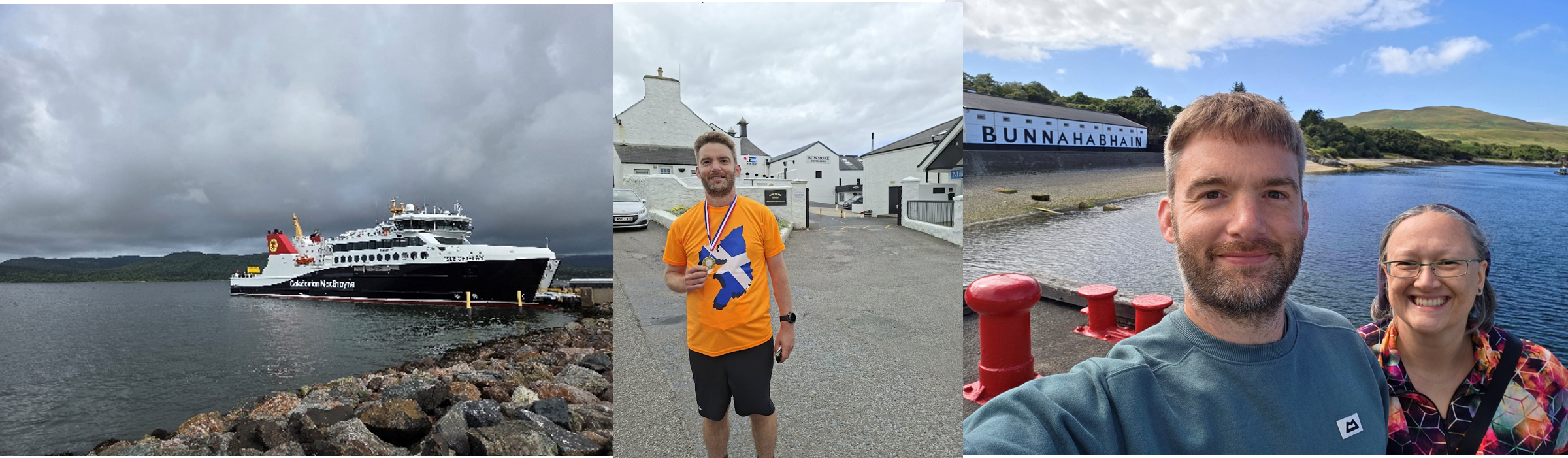
You’d have thought that at the age of 40, I would know how to run. Yet the truth is that I’ve not often thought about how I should run, or put much time into analysing my running technique. It’s just something that I go out and do regularly, without thinking about it very much, as running for me is often the time when I process everything else going on at home or in church life.
However, in the past year or so, I have noticed that my running motion has been a bit flat. It seems the long-distance events I’ve taken part in have gradually led to a more ‘shuffling’ running style creeping in, with less spring in my step. Form has gone out of the window when miles simply need to be completed come what may.
On holiday, I’ve been reading the book ‘The Lost Art of Running – A Journey to Rediscover the Forgotten Essence of Human Movement’ by a renowned running coach, Shane Benzie. He is adamant that above all else, runners should be making sure that they are moving in ways that we have naturally evolved to run. Good posture, running in an upright position, head up looking to the horizon, rather than being hunched over or shuffling, is a key part of this (our modern-day lifestyle encourages bad posture, sat at desks and looking down at screens all the time). Better posture leads to more efficient movement that puts the elastic qualities within the body to full use, thus allowing for greater speed without increased effort. Benzie argues that when things get tough in a race or training run, it is much better to focus on moving well than it is to focus on the problems that are being encountered, such as the nature of the terrain or the number of miles left. This allows the runner to work with the terrain and the environment rather than against it.
So, at the age of 40, I’m now trying to amend my running style to be more efficient, and rediscover some of the spring in my step that has been lost in the last few years. Hopefully, this aging dog can learn some new tricks.
It might well be, for those of us who have been Christians for a long time, practising our faith for decades, that, much like my running, you might expect there is little left to learn. On Sunday, we will come across Matthew’s account of Peter stepping out in faith in order to walk on water, just as Jesus did. It starts so well, he makes some progress across the water, then it all goes horribly wrong as he starts to get distracted by the wind and the waves. The impossibility of the situation and all the things that could go wrong crowd in, and all of a sudden he is sinking under the water. He calls out to Jesus, who reaches down and pulls him out of the water, returning him safely to the boat.
In the life of faith, as we step out into the world around us, away from the safety of our boat, I wonder if we might take some lessons from Shane Benzie and his approach to coaching running. Peter got overawed by the problems around him and overlooked the essential thing required in order to move forward. He took his eyes off Jesus, the Lord of all creation, and focused instead on the overwhelming storm that he was powerless to fight.
In Jesus, Peter had in front of him the word of life, the one who could bring healing, cast out demons, and restore calm to the chaotic waters he walked upon. To step out in faith, as we walk with Christ, is so much more sustainable when we are able to focus on moving well as a disciple, remembering that Christ is with us, and calling upon his name through all of the chaotic and challenging parts of life that we encounter. When we do this, keeping Christ as the focal point on our horizon, we might be freed to stop fighting against the chaos that surrounds us, working with it instead, as we bring hope, peace, and new life in his name.
Sunday, 02 August 2026 — Walking Together by Revd Dr Paul Fiddes
One of the key phrases from our history as Baptists is “walking together”. Early Baptist covenants usually contained the church members’ promise to “walk together before God and to watch over each other”, and we use the same promise whenever we re-make our covenant at New Road. It’s striking, then, that there has recently been a widespread movement in the Roman Catholic Church to encourage “walking together”, initiated by the late Pope Francis I and re-affirmed by Pope Leo XIV.
The technical term our Catholic friends have used is “synodality”, which simply means “Together (syn) on the way (hodos)”, and the phrase “walking together” appears many times. For example, “synodality” is defined in a major document as being “Christians walking in communion with Christ toward the Kingdom along with the whole of humanity”, and a report on the movement stresses that ‘If becoming synodal means walking together with the One who is the Way, a synodal Church needs to put those experiencing poverty at the centre of all aspects of its life.” So a central part of the process is to enable the church to listen to all voices, from all ages, all ethnicities, and from all parts of society, in discerning its path forward into the future. Pope Francis put it like this: “A synodal Church is a Church which listens…the faithful people, the bishops, all listening to each other; and all listening to the Holy Spirit.”
Baptists have been involved in talking with scholars and church leaders in the Catholic Church about this process of “walking together” during the last two years. A number of UK Baptists were part of an important Catholic conference in Durham in 2023 called “Learning on the Way”, when the aim was for those from different Christian confessions to listen to each other and learn from each other “on the way”. There were also representatives of the Baptist World Alliance (two women theologians) at meetings in Rome which were “synods about synodality” in 2024 and 2025. Just this last week a book of essays by Baptist writers has been published, reflecting on what the “synodal way” means. Edited by myself, Andy Goodliff, and Ruth Moriarty, Walking Together; Baptists and Synodality explores how we can “walk together” in our local church meetings, in associations, in the Union and in our world-wide fellowship. You can get the book from Amazon for the price of £24.00 or as an e-book for £7.46.
The book has been prompted by this new Catholic emphasis on the synodal pathway and is in dialogue with it. Baptists may think—rightly, I suggest—that they have something to contribute from their long experience of walking together in covenant and seeking to discern the mind of Christ in the church meeting. But we also need to listen to the Catholic emphasis on listening to the voices from the margins of society, the voices of the poor and the powerless, those outside as well as inside the church. If we are to allow these to speak and shape our “walking together” we may need to re-think the ways that we seek to find the purpose of Christ for us in our local community.